

📰 Quillan Faces Political Shake-Up as Town Strengthens Outdoor Tourism Appeal
Quillan, Aude – 2026
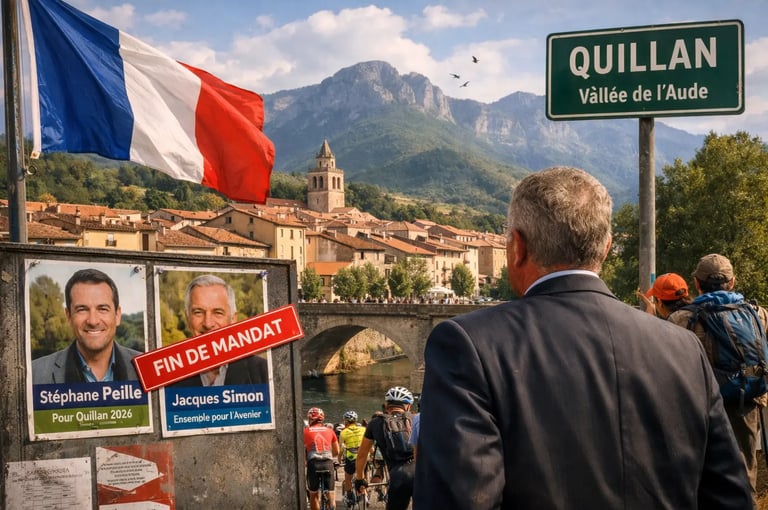
The mountain town of Quillan, nestled in the Upper Aude Valley at the foothills of the Pyrenees, is undergoing a significant political transition following a dramatic first round in the 2026 municipal elections—while continuing to build momentum as a leading destination for outdoor tourism in southern France.
Incumbent Eliminated in Unexpected First Round Result
In a closely contested three-way race, Stéphane Peille emerged in the lead with just over 40% of the vote, followed by independent candidate Jacques Simon on approximately 30%.
In a surprising development, long-standing mayor Pierre Castel was eliminated after finishing third—an uncommon outcome in local municipal elections.
Following the result, Castel announced his withdrawal from the race after failing to reach an agreement to merge lists with Simon, effectively ending his political career and reshaping the electoral landscape ahead of the second round.
A Runoff Framed by Change and Renewal
The withdrawal of the incumbent has transformed the election into a two-candidate contest, reflecting a broader shift within the town.
Local debate has centred on:
economic revitalisation
access and transport infrastructure
the future of public services
and the long-term positioning of Quillan as a destination
While the political outcome remains uncertain, there is growing consensus on one point: the need to strengthen Quillan’s appeal beyond its traditional base.
Tourism Emerges as a Strategic Priority
Set along the River Aude and surrounded by forested hills and mountain terrain, Quillan is increasingly attracting visitors seeking nature-based experiences.
The town and surrounding Pyrénées Audoises region offer:
established hiking and trail-running routes
cycling and motorcycling circuits through mountain passes
freshwater activities including fishing and kayaking
proximity to historic Cathar sites
Local events such as trail races, cycling competitions and seasonal festivals continue to draw participants from across France and beyond, reinforcing the area’s growing reputation.
Outdoor Events Driving Visitor Growth
Annual events—including trail running competitions, mountain biking races and hiking festivals—have become central to Quillan’s tourism strategy.
These gatherings not only boost visitor numbers but also position the town within a wider regional movement toward:
sustainable tourism
active travel
and rural destination experiences
The approach reflects broader trends across southern France, where smaller towns are capitalising on natural assets to attract new audiences.
Access Remains Car-Focused
Despite its rural location, Quillan remains accessible via regional transport links. The town is located approximately one hour from Carcassonne Airport, with additional connections via bus services.
However, with the local railway line still inactive, most visitors rely on car travel—often combining Quillan with wider exploration of the Aude region and Pyrenean foothills.
A Town Looking Forward
As the election moves toward its conclusion, Quillan finds itself at a crossroads—politically and economically.
Yet amid the uncertainty, one direction appears clear.
The town is actively enhancing its appeal as a destination for outdoor tourism, building on its natural environment, expanding its events calendar and aligning with evolving travel trends.
For visitors, the result is a destination that is both authentic and evolving—where local change is matched by a growing openness to the outside world.
Author Camille Aubert
Publish-date 2026-03-18
Update: Election Outcome and What to Watch Next
Following the second round of the 2026 municipal elections, Stéphane Peille has been elected mayor of Quillan with just over 52% of the vote, defeating independent candidate Jacques Simon in a closely fought runoff.
The result confirms a shift in local leadership after the unexpected first-round elimination of long-standing mayor Pierre Castel, and marks the beginning of a new political cycle for the town.
With a clear majority on the municipal council, the incoming administration is now in a position to implement its programme — with several key areas likely to shape Quillan’s direction over the coming years.
What to Watch
1. Investment in Access and Infrastructure
Improving transport links remains a recurring local issue. While Quillan is accessible by road, future developments may focus on road connectivity, parking capacity, and the long-discussed prospects around regional rail links or enhanced public transport options.
2. Positioning Quillan as an Outdoor Destination
Tourism — particularly outdoor and nature-based tourism — is expected to remain a strategic priority. Watch for:
Expansion of hiking and cycling networks
Support for organised events such as trail races and cycling sportives
Partnerships within the wider Pyrénées Audoises region
3. Local Economy and Year-Round Activity
Beyond seasonal tourism, there is likely to be emphasis on sustaining year-round economic activity, including:
Supporting local businesses
Encouraging longer visitor stays
Balancing tourism growth with everyday village life
4. Public Services and Town Vitality
Like many rural towns in southern France, maintaining access to public services and preserving community infrastructure will remain central. Any changes in this area may directly influence both residents and visitors.
A Period of Transition
While election campaigns often set broad priorities, the pace and scale of implementation will become clearer over time. Early council decisions, budget allocations, and regional partnerships will offer the first indications of how these ambitions translate into action.
For visitors and property owners alike, the coming months represent a period to watch — as Quillan continues to evolve both as a working French town and as a destination shaped by its natural surroundings.
Author Camille Aubert
Publish-date 2026-04-28
